When it comes to most things, new is undoubtedly better than old. Yet, if you find yourself discussing new versus old with a watch collector, this doesn’t always ring true.
Typically, there are fundamental differences between new and old watches that can be either an advantage or a drawback. New watches can offer advanced performance, accuracy, and materials, while old watches are prized for their historical significance, rarity, and potential for appreciation.
Whether an old watch or a new watch is ‘better’ even comes down to the models you’re comparing. Below, we compare both new and old references to highlight the key differences and why they’re causing such a debate.
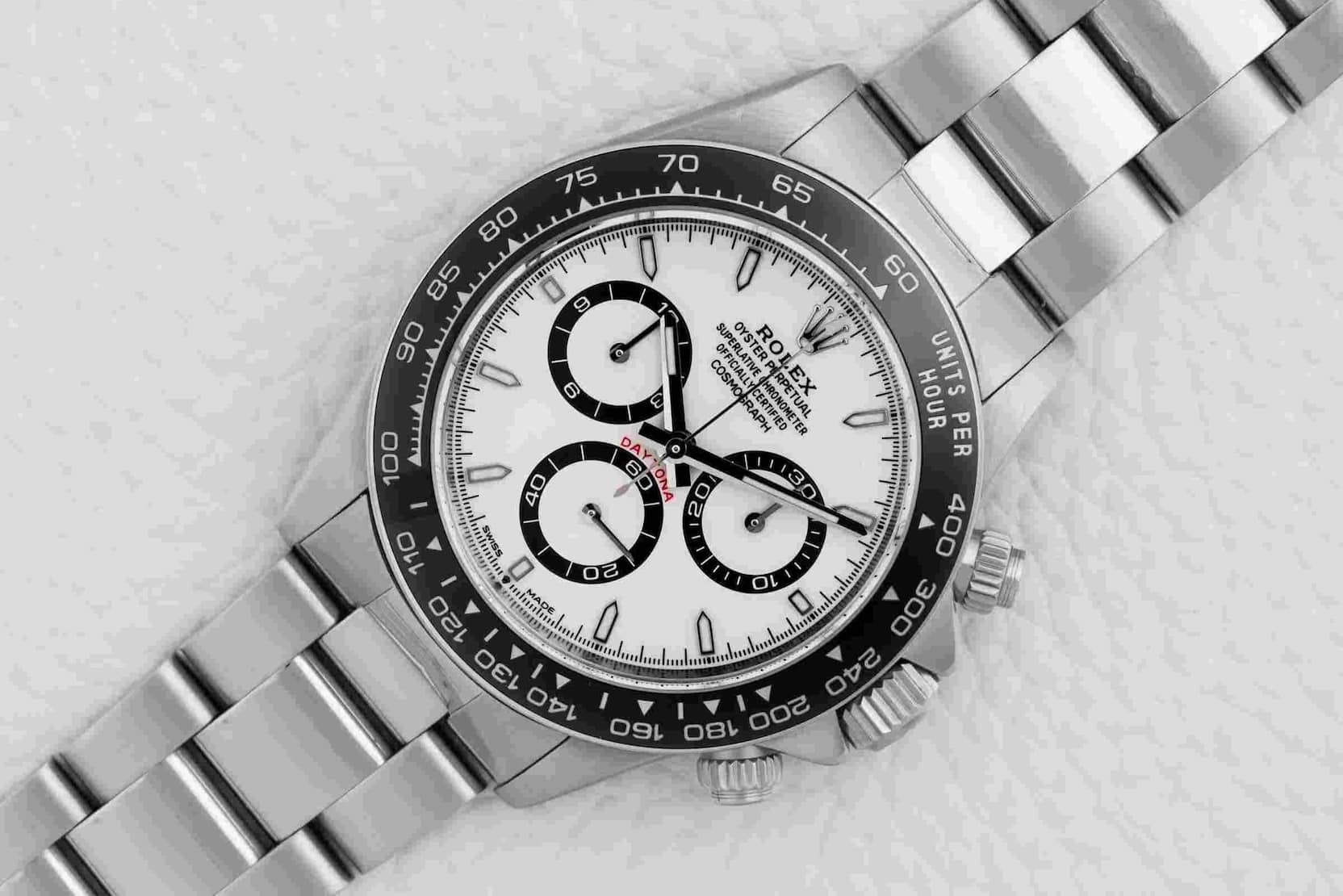
Rolex Daytona ‘Panda’ – 116500LN vs. 126500LN
It’s clear to see that Rolex stuck with a winning formula when creating both the 116500LN and 126500LN references. Both ‘Panda’ watches are very similar: the 116500LN was produced from 2016 to 2023, and the 126500LN from 2023 onwards. However, there certainly are some key differences between the two.
- Movement: The 116500LN features Caliber 4130 with a 72-hour power reserve, while the 126500LN boasts the new-generation 4131 with greater efficiency and a 72-hour power reserve. This movement upgrade in the 126500LN is more about future-proofing than daily use.
- Case and lugs: The 116500LN is slightly thinner and more balanced than the 126500LN, while its lugs are also more symmetrical for a more refined fit. On the wrist, the 116500LN is chunkier and sportier, while the 126500LN is cleaner and more elegant.
- Bracelet: There have been only subtle updates from the 116500LN to the 126500LN. The 116500LN has an oyster bracelet with solid links – with the inner links polished and the outer links brushed. There is an Easylink 5mm adjustment, along with an older end-link and clasp geometry. The newer 126500LN differs slightly with reshaped end links and an enhanced clasp for a more comfortable fit.
- Bezel design: The bezel design differences are immediately noticeable. While the 116500LN has a solid ceramic bezel with no outer metal ring, the 126500LN has a slim metallic, stainless-steel edge around the black ceramic insert. The 126500LN also has a more premium/framed look and enhances perceptions of durability, but many collectors prefer the older, pure ceramic edge.
The Winner: 116500LN
There’s no denying that collectors love many aspects of the 126500LN, such as the new technology, the modern aesthetic tweaks, and its potential long-term value. However, the earlier 116500LN comes out on top with many collectors.
The 116500LN features a purer design, more balanced dials, and additional features that enhance comfort for the wearer, such as case curves and reduced overall bulk.
John Mayer vs. John Mayer 2.0 (Masters)
The ‘John Mayer’ Daytona refers to the yellow gold Daytona watch with a green dial by Rolex. Officially known as the Rolex Daytona 116508, this watch gained cult status after musician and Rolex collector John Mayer vocally endorsed it. That endorsement, coupled with its discontinuation in 2023, has made it a highly desirable collector’s piece.
However, that wasn’t the last we were going to see from the John Mayer watch. In 2025, Rolex released the Rolex Cosmograph Daytona 126508, also known as the ‘Masters’ and ‘John Mayer 2.0,’ as a refreshed version of the Daytona 116508. It features a bright green and golden dial, spray-coated counters, 18-carat gold applique hour markers, and a range of advanced features.
- Movement: The John Mayer Daytona 116508 features the standard Daytona movement, Caliber 4130, with a 72-hour power reserve, whereas the Masters boasts the Caliber 4131 with perpetual, mechanical chronograph, self-winding movement. Other specifications are similar to those of the original John Mayer Daytona, including an approximate 72-hour power reserve.
- Sub-dials: The sub-dials on the John Mayer vs. the John Mayer 2.0 are noteworthy: the original 116508 features tone-on-tone green sub-dials to match the sunburst green dial, while the 126508 has contrasting champagne-gold sub-dials. This color creates a panda-style effect, similar to vintage Paul Newman Daytonas.
- Green shade: While both the 116508 and 126508 have green dials, the shade of green differs between them. The original 116508 has a deep sunburst green, while the 126508’s green is slightly brighter.
- Markers and text: The typography of the 126508 is more subtle and refined than that of the original 116508, while the hour markers are longer and slimmer.
- Case and lugs: Both the 116508 and 126508 feature an eye-catching 40mm yellow-gold case and a matching gold bezel. However, the 126508 has a fixed bezel with an engraved tachymetric scale in 18-carat yellow gold. The 126508 has a slightly more refined, slimmer case with tapered lugs for improved comfort.
- Bezel: There are subtle bezel differences to observe. The 126508 has a thin gold ring around the bezel edge, but this detail is absent on the 116508.
- Bracelet: You’ll find an elegant gold oyster bracelet on the 116508 bracelet and an oyster bracelet with three-piece solid links in 18-carat yellow gold on the 126508.
The Winner: A Tie
There is no unanimous winner, with both the John Mayer Daytona 116508 and the more recent Daytona 126508 offering something exciting for collectors. Some collectors appreciate the classic appeal of the John Mayer Daytona, particularly its green dial paired with yellow gold, which adds a ‘wow’ factor. Its scarcity, due to its discontinuation, also drives its desirability.
Others prefer the new, more advanced features of the more recent Rolex Cosmograph Daytona 126508. It features an updated Caliber, offering the latest movement with improved efficiency and enhanced shock resistance compared to the previous model. It also has a refined, contemporary design, a sleeker case, and a more modern, vibrant, and lacquered green finish.
Rolex Platona – 116506 vs. 126506
The Rolex Platona 116506 was released in 2013 to celebrate the 50th anniversary of the Daytona. It was the first platinum Daytona ever made and quickly entered collections around the world. A decade later, the 126506 was released as an updated version with meaningful changes.
- Movement and case back: The 116506 is powered by the ever-popular Caliber 4130, renowned for its reliability. Hiding the movement is a solid 950 platinum caseback. The 126506 was updated to the Caliber 4131, which features a more refined finish and improved efficiency with a skeletonized 18-carat yellow gold oscillating weight and Côte de Genève decoration.
- Case and lugs: When comparing the case and lugs, the 126506 undoubtedly shows more refinement and elegance than the 116506. The lugs on the 126506 have been redesigned to be angled and slightly thinner. The crown guards are also more streamlined.
- Dial: The hour markers on the 126506 are more elongated and slimmer, while the subdials feature narrower, more delicate rings.
- Bezel: You’ll notice that the 116506 has a ceramic bezel edge that meets the case directly, whereas the 126506 has a thin platinum ring that surrounds the brown Cerachrom bezel.
- Bracelet: Both Rolex Platona models have a heavy platinum oyster bracelet with polished center links and brushed outer links. However, comfort has also been prioritized in the 126506 reference with reshaped end links, an updated clasp, and improved taper.
The Winner:
It’s clear to see that the 126506 is desirable for its technological upgrades and improved comfort. However, the original 116506 still finds favor with collectors. It’s prized for being the very first Platona, so it’s seen as more pure and iconic.
Audemars Piguet Royal Oak – 15500 vs. 15510
To someone who doesn’t collect watches, the Audemars Piguet Royal Oak 15500 and 15510 are the same watch. These watches do, indeed, look similar. However, we’ll cover their key differences below.
The Audemars Piguet Royal Oak 15500 was introduced in 2019 as the successor to the 15400 model. The goal was to modernize the design and case proportions. To coincide with the Royal Oak’s 50th anniversary, the 15510 was launched by Audemars Piguet in 2022. This model underwent a few design and movement updates.
- Movement: The 15500 features Audemars Piguet’s in-house automatic movement, the Caliber 4302, which has a 70-hour power reserve. The 15510 has the same Caliber but features an updated openworked rotor and more refined finishing. It, too, has a 70-hour power reserve.
- Dial and branding: The most obvious dial and branding differences are the removal of the AP monogram at 6 o’clock on the 15510. Audemars Piguet opted for a cleaner look on this model, preferring simple white gold Audemars Piguet text. The hour markers on the 15510 are also longer and thinner than those on the 15500.
- Case and bezel: Both references have 41mm stainless-steel cases, but the 15510 has a thinner, more refined profile and a wider bevel on the bezel for more light reflection.
- Bracelet: Both models have a Royal Oak integrated bracelet with polished bevels and brushed finishing. However, the 15510 has thinner links and a reworked clasp for a sleeker appearance.
- Rotor: The rotor is a feature that will be noticeable to the most discerning collectors. The 15510 models released in 2022 have a special ‘50th Anniversary’ rotor, whereas the 15500s have the standard AP logo rotor.
The Winner: 15510
It’s not often that a newer model wins the hearts of collectors, but that appears to be the case with the Audemars Piguet Royal Oak 15510. The 15500 laid the groundwork to modernize the reference from the previous 15400 model, but the 15510 is where all the refinements and upgrades have truly shone. Collectors also love how the 15510 is slimmer and more balanced.
Patek Philippe Nautilus – 5980 vs 5990
As a collector, it can be hard to decide whether the Patek Philippe Nautilus 5980 or 5990 is more desirable and deserving of space in a collection. Both come from the same family but serve different purposes.
The 5980 was launched in 2006 and was the first Nautilus to feature a chronograph. The 5990 followed in 2014, known as the ‘Travel Time Chronograph’ with a chronograph featuring a dual timezone. The iconic design was maintained, but this reference undoubtedly had more functionality than its predecessor.
- Movement: The 5980 is powered by the Caliber CH 28-520 C, which is an automatic flyback chronograph movement. The 5990 has a Caliber CH 28-520 C FUS.
- Complications and dial: The 5980 is highly regarded for its simplicity, with a single, combined monocounter at 6 o’clock for chronograph minutes and hours. However, on the 5990, this feature is replaced with a 60-minute counter. There is also a date subdial at 12 o’clock with two day/night indicators: ‘Local’ at 9 o’clock and ‘Home’ at 3 o’clock.
- Case: Both watches have 40.5mm cases, but they aren’t quite the same. The 5980’s case is clean and rounded, while the 5990 has pushers on the left case flank to adjust the second timezone. As a result, the case is also slightly thicker. In terms of design, the 5990 is generally considered more formal and complex.
- Bracelet: There are no structural changes between the models; both feature a Nautilus bracelet with brushed links and polished bevels. However, due to the 5990’s added features, it wears heavier.
The Winner: 5980
For frequent travelers, the 5990 is a practical companion that will take pride of place on your bedside cabinet. However, in terms of collector desirability, the 5980 often takes the top spot. It’s more aesthetically harmonious with a purer design and cleaner dial layout. It’s also more historically significant since it’s the first Nautilus Chronograph.
Vacheron Constantin Overseas – 4500V vs. 4520V
The Vacheron Constantin Overseas is considered the flagship of the sports-luxury line. The 4500V was first introduced in 2016, and the 4520V followed in 2023 as a more elegant, refined, and wearable timepiece.
- Movement: The Vacheron Constantin Overseas 4500V features the manufacturer’s in-house Caliber 5100, with a 60-hour power reserve and visible center rotor through the sapphire caseback. The 4520V has a Caliber 4400 with a 60-hour power reserve.
- Case thickness & lugs: While both models have 41mm stainless-steel cases, the 4500V is 11mm thick, compared to the 4520V’s 8mm. As a result, the 4520V is one of the slimmest sports-luxury watches on the market. Its lugs are also angled for a better fit.
- Bracelet and taper: Both references feature the signature quick-change system, allowing wearers to swap between the stainless-steel bracelet, rubber strap, and leather strap. However, the 4520V model wears more comfortably due to its lighter weight and because it tapers aggressively from the lug to the clasp.
- Rotor design: The 4520V has a solid rotor design, while the 4500V has cutouts.
The Winner: 4500V
Collectors admire the slim profile and elegance of the 4520V, but the broad appeal and versatility of the 4500V make it the preferred option by many collectors.
Explore the Best Luxury Watches in DFW with WOLVYN
Whether you prefer the modernity and technology of new watches or the historical significance of old watches, you can find a broad range of options to suit your tastes at WOLVYN in Dallas-Fort Worth. Explore our leading brands today, including Rolex, Patek Philippe, Richard Mille, Audemars Piguet, and Cartier.